Core architecture
pVisor organizes Agent CLIs, scripts and automation commands into manageable Jobs: it resolves policy and execution boundaries before launch, manages file, network and machine resources during execution, and retains reviewable results afterward. Operations describe requests; Events describe facts observed while processing them.
There are two responsibilities: core provides definitions; pvisor provides implementation. External callers submit execution requests, control execution through a run handle and observe progress and results through Events.
For the overall diagram and an end-to-end task walkthrough see Design and internals. The contracts below cover crate ownership, API boundaries and the host authority path.
Definitions and implementation
| Owner | Responsibility |
|---|---|
pvisor-core |
Operation, policy decisions, Placement, Outcome, Event and shared interaction contracts; pure validation and policy evaluation |
pvisor |
Request parsing, capability admission, actual policy rewrites, placement selection, scheduling, execution and Attempt lifecycle |
pvisor-journal |
Event commit, receipts, deduplication, causal reference validation and recovery |
pvisor-overlay-core |
File authorization integration, copy-on-write, preimages, review/apply/recovery/drop |
pvisor-overlayfs |
Host FUSE mounts and file operation integration |
pvisor-overlaynet |
Network parsing, proxy forwarding and VM networking; enforcement of core policy definitions |
pvisor-guest |
VM PID 1 and command launch contract |
pvisor-gateway |
Optional model protocol routing, conversion and call observation |
pvisor-daemon |
Separate single-node sandbox admission, durable ownership, native VM supervisor lifecycle and endpoint proxy |
pvisor-cli |
CLI, TUI, cache/replay frontends and Host Job application adapters; consumes the runtime |
pvisor-shim |
containerd Runtime v2 shim (io.containerd.pvisor.v2); lifecycle, exec and FIFO/PTY IO for OCI container and optional VM execution tiers |
pvisor-vm |
VMs, devices, freezing, snapshots and RAM mappings; uniform api and private platform implementations |
pvisor-replay |
Agent trajectory replay mechanisms; consumes Core/Journal contracts, with frontends in CLI |
The daemon VM-only NativeRuntime starts execution through durable RuntimeJobService in independent supervisors and reuses in-process AttemptService for controls on the same live Attempt. It retains RunHandles and VMs across API restart; the daemon separately owns SDK authentication, admission and confirmed cleanup. Native Job stage/apply, checkpoint/fork and Gateway interfaces keep separate ownership and are not automatically exposed through runtime reuse.
Core neither owns the execution loop nor starts processes or opens control sockets. pvisor implements AgentCtl clients/servers and approval sockets. Drivers implement file, network and isolation boundaries. The default core does not depend on Gateway, TUI or replay; the gateway feature enables capture.
Technical layers and resource ownership
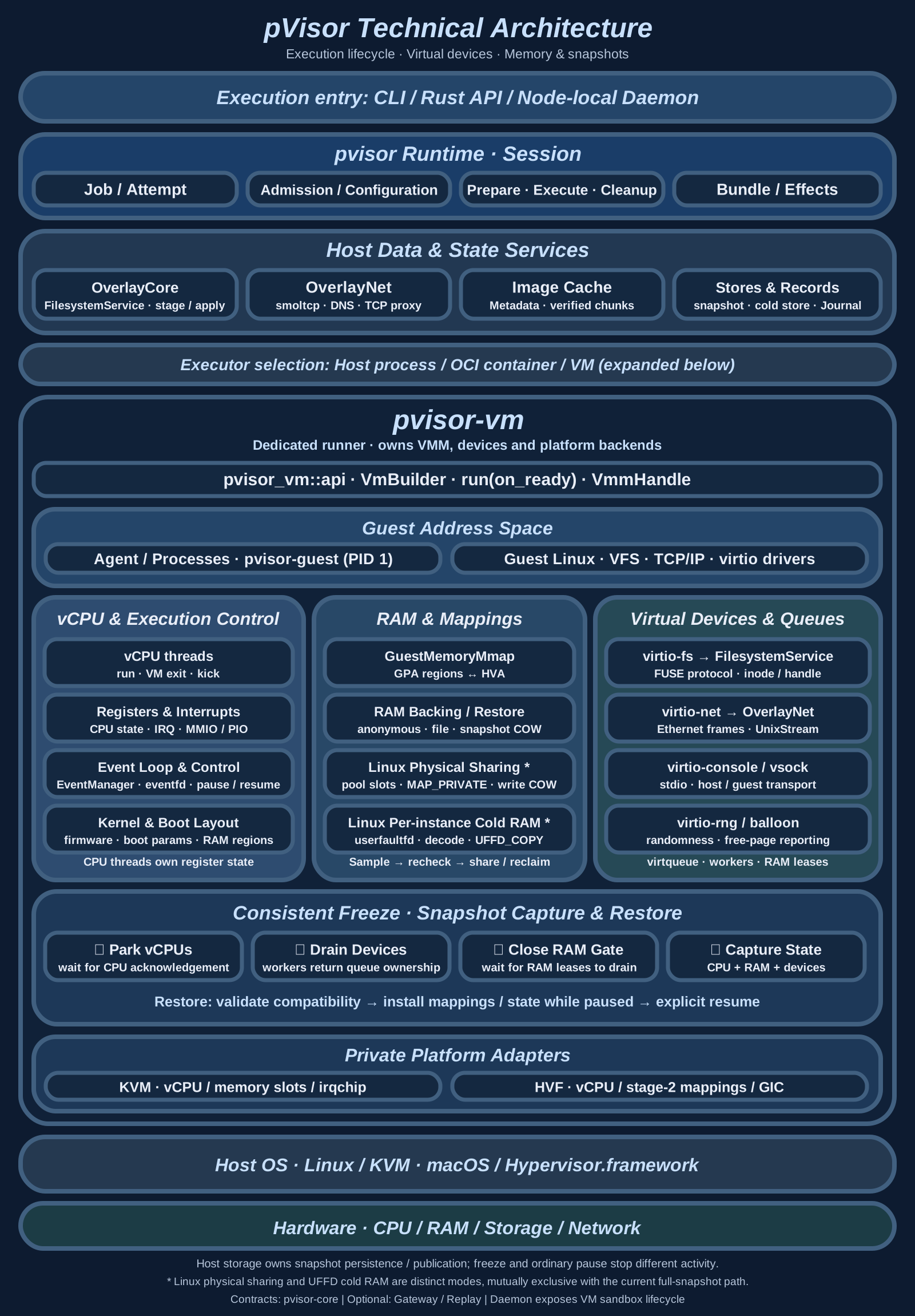
Entries submit configuration, Runtime organizes Sessions and Attempts, and host services provide files, networking, images and durable storage. Host, OCI and VM are distinct execution paths; the diagram expands VM state and its host relationships below. Crate dependencies express code reuse. Resource ownership determines who stops, synchronizes and releases state.
Host data services
File paths converge at FilesystemService. Host FUSE / FSKit adapters and the VM virtio-fs entry share OverlayCore authorization, layered lookup, copy-up and preimage semantics. Each entry retains its inode, handle, protocol-permission and queue state. The VM calls the file service directly without an intermediate host FUSE mount. Staged candidates and target workspace files have separate publication points; Filesystem design owns write and recovery ordering.
OverlayNet owns connection authorization and forwarding. VM virtio-net delivers Ethernet frames to the host userspace data plane. Explicit proxy and VM NIC attachment have different coverage. Optional Gateway consumes model-protocol requests for routing, conversion, credential delegation and capture; ordinary network forwarding does not automatically acquire model semantics. See Network design and Gateway for attachment relationships.
The image cache supplies pinned-revision metadata and verified content reads to the file service. The VM owns live mappings and device state; host storage owns image objects, RAM backing, snapshot directories and publication transactions. Cache hits, shared file contents and shared physical RAM pages belong to different layers. Shared image cache and Memory mechanisms own their reference and reclamation rules.
State inside a VM
pvisor_vm::api accepts configuration and resource ownership. VmRuntime::run starts one VM in a dedicated runner and supplies VmmHandle through the ready callback. The handle provides control without extending VM lifetime. The caller still supervises the runner, binds file/network resources, and owns snapshot compatibility and persistence.
| State | Owner and collaboration boundary |
|---|---|
| Guest processes | pvisor-guest is Linux PID 1: it launches workloads, reaps descendants and synchronizes visible virtio-fs mounts before reporting exit |
| vCPU and execution control | pvisor-vm owns CPU threads, registers, interrupts and the event loop; KVM / HVF adapters remain inside the crate |
| RAM and mappings | pvisor-vm manages GPA/HVA, backing and mapping lifetimes; host storage adapters manage referenced files or blocks |
| Virtual devices | The queue owner publishes the used ring; workers and RAM leases keep request buffers valid during processing |
| Freeze and restore | The VM coordinates CPU parking, device draining and the RAM gate; callers save and publish matching machine/file state within the freeze window |
Ordinary pause confirms CPU parking while devices may still access RAM. Full freeze must also handle queues and memory references. Restore validates compatibility, installs mappings/device state while paused, then explicitly resumes. Physical sharing, cold pages and offload depend on platform, backing and profile; they cannot be assumed simultaneously available. VM design and Environment snapshots own call ordering and post-failure state.
Source entry points: pvisor/src/session/lifecycle.rs, pvisor-overlay-core/src/service.rs, pvisor/src/image/cache/backend.rs, pvisor-vm/src/api.rs, handle.rs and devices/virtio/.
API boundaries and migration status
Logical crate responsibilities and Rust visibility require separate checks. Only pvisor-vm, pvisor-overlayfs and pvisor-journal currently use a sole api entry point. Other crates retain existing interfaces; layering in an architecture diagram does not establish a completed workspace migration.
| Crate | Current public boundary | Implementation and resource ownership |
|---|---|---|
pvisor-vm |
pvisor_vm::api; trait-based use of VmBuilder and VmmHandle |
Private backend, VMM, devices, RAM and platform dispatch |
pvisor-overlayfs |
pvisor_overlayfs::api; configuration, mount, session and metrics contracts |
Private fs, mount and observation; owns neither apply nor Run lifecycle |
pvisor-journal |
pvisor_journal::api; JournalStore, TraceProducer, DurableFiles |
Private journal, trace, persistence; Core owns Event/Receipt |
pvisor-core |
Domain modules and root re-exports; not migrated | Shared identities, protocols, pure validation and policy definitions; no execution resources |
pvisor-overlay-core, pvisor-overlaynet |
Existing public modules and root interfaces; not migrated | File semantics, dual-entry file service, proxies and egress data plane |
pvisor, Gateway, Replay, Daemon and others |
Retain existing entries; no uniform sole-api model yet |
Continue evolving within actual lifecycle and domain boundaries |
Migrated api modules declare public data, fields and trait methods. Opaque owners may be re-exported from private implementations while retaining private state. Method bodies, validation, platform dispatch and resource management live in implementations; public traits have no default bodies. Callers import contracts from the owning crate's api. Declarations keep the same shape across supported platforms/features; capability queries and explicit unsupported errors describe actual support.
Migration proceeds one crate at a time, updating its consumers, README, public documentation and boundary checks together while preserving external contract coverage. Unmigrated crates should not gain blanket re-export layers or duplicate DTOs merely to appear uniform, nor expose internals to bypass compilation boundaries. Hardware/private-state checks remain inside the crate; callers rely on ownership, lifecycle, post-failure state and synchronization contracts.
This Rust boundary does not automatically establish stable wire protocols or old-record compatibility. The frontend verifies the same binary when self-executing its owner; later CLIs use instance-protocol compatibility without requiring matching binary digests. Stored formats have independent readers. See Records and version matrix. Status follows static inspection of lib.rs, VM runtime_modules.rs, api.rs and directory READMEs; it does not claim fresh contract-test or platform validation.
Host and Guest AgentCtl
Host AgentCtl is the authority path for built-in Job CLI operations. Guest
AgentCtl is the per-Attempt cooperation path for workload Hello/Sync, client
state, directives and checkpoint quiescence. They have separate schemas,
credentials and endpoints: a guest cooperation token never authorizes host Job,
VM, staged-file or daemon-supervisor controls. The Bundle's agentctl snapshot
still describes Guest cooperation, not a Host authorization receipt.
Job owner and request ownership
pvisor spawn keeps a terminal frontend and one self-executed owner. They inherit
stdio and exchange cancellation/exit information over a private socketpair. The
owner stays in the original session in a separate process group. Interactive
execution uses the original controlling terminal, with foreground ownership
restored at exit; terminal Ctrl-C may reach the workload directly. Linux makes
the owner the subreaper and retains pidfd-based descendant cleanup.
Before executor entry, the owner binds a private socket and writes live_control
to the host-only Job record. The canonical address is:
Directories are same-UID, non-symlink and 0700; the socket is 0600. The record
binds its path to device/inode, protocol, owner PID and starting binary identity.
Clients authenticate peer UID and check the socket identity before and after
connecting. Executors exclude the whole authority root from guest views. Terminal
publication clears discovery; the owner removes only its own socket inode.
Embedded runs publish the same record when storage is retained.
Live status, kill, native VM transitions, execution capture and running inspect
execute in the starting owner binary. Stopped status, review, apply, drop and
inspect run directly in the calling process. Sealed checkpoint restoration/fork
starts a new owner. Apply/drop refuse a valid owner still holding stage. Durable
operations use exclusive flock on the Job root's job.lock, validated as an
owned 0600 file with one hard link. Its diagnostic record contains the lock
protocol, PID and operation. Unknown Job schemas refuse mutation. Residual owner
metadata can be cleared only after its process dies and no valid control endpoint
remains. Read-only inspect uses stage-declared lower mutability, defaulting to
Mutable for missing or rebound declarations; freshness is not guaranteed.
Existing internal channels and cleanup order
The runtime still retains these internal channels inside the Job's process. They add no user-wide persistent process.
| Channel | Current callers and implementation | Planned consolidation |
|---|---|---|
| Overlay control | registry.rs::RunControlServer discovers its private endpoint through the stage's control.sock link; owner status queries itself, the TUI still reads observations, and the old inspect mount table duplicates owner inspect |
Migrate TUI observations and SDK callers before removing old inspect branches, the listener and link discovery |
| Native execution capture | job_execution.rs::Server retains execution.sock; after receiving capture, the owner still calls itself through this runtime endpoint |
Call directly inside the owner while preserving request receipts, operation locks, freezing and suspended-head terminal confirmation |
| Explicit VM debugging | --vm-socket and embedded host_vm_exchange use a separate asynchronous exchange; record discovery uses LiveControlRecord::exchange_checked |
Share bounded, cancellable transport while retaining the public SDK adapter |
Cleanup first unifies debug transport, then narrows owner bootstrap messages to
run, fork and resume. JobCommand currently serializes all commands although
only those three cross the socketpair; other commands' serialization, owner
terminal branches and round-trip tests can then be removed. Production callers
always pass zero for OwnedTree.excluded; Completion.signal has no reader,
and restoration's vm_control_socket(None) always returns None. These cleanups
are pending. Channel consolidation must migrate callers and contract tests
together.
Wire contract and upgrades
The instance contract is named pvisor-instance-control-1. Core's version-1 Host
envelopes carry correlation, exact Job/Attempt targets and typed results/errors.
runtime/host_transport.rs retains newline JSON framing with a 1 MiB frame limit.
The owner admits at most eight connections and uses existing operation locks for
mutations. The public socket receives no terminal descriptors or guest tokens.
Internal CLI DTOs bootstrap only the self-executed owner.
Caller and owner binaries may differ when the instance protocol matches. An
incompatible Job protocol identifies that owner's recorded binary; it does not
block other Jobs. Before upgrading, drain old Jobs and stop the old
--pvisor-internal-host with the old binary. New CLIs never connect to old
<generation>.sock endpoints. Records without live discovery expose disk state
only, and do not discover old running VMs. The daemon supervisor's listener,
private credentials, framing and admission remain unchanged.
Cancellation and validation limits
Signal handlers are installed before the owner unblocks SIGINT/SIGTERM/SIGHUP.
The frontend reaps its owner child; the owner handles cancellation, disconnection
and descendants. Linux uses subreaper adoption, /proc discovery and pidfds.
macOS retains birth-identity checks and polling: missed reparented orphans are not
guaranteed contained, and numeric signals are not atomic pidfd operations. Loaded
Mach-O UUID verification is not byte-for-byte memory attestation. Moving the
listener does not establish additional macOS isolation guarantees.
Lost responses, timeouts and cancellation can follow accepted effects. The
record-discovery path reports uncertainty and never retries automatically.
The current --vm-socket debug path still awaits the old asynchronous exchange:
Ctrl-C does not interrupt its response wait, and underlying disconnect errors
may omit the uncertainty warning. This implementation gap awaits consolidation.
Reconcile state after a disconnect on either path. Scoped checkpoint receipts
do not provide universal exactly-once delivery.
Transport/process tests do not establish guest correctness or real-VM TUI coverage.
A production execution path
The runtime resolves RunSpec, effective policy and executor capabilities before preparing filesystem, network and execution attachments. It calls RunExecutor::execute only after required launch facts commit successfully. Preparation may already have created directories or sockets, so a commit failure still requires resource cleanup.
The executor returns ExecutorOutput; the Session continues with cleanup, observation checks and result storage.
For example, when a request allows networking but workspace policy denies it, admission derives an effective network configuration and passes the same configuration to the network driver and executor. Preparation must not reread mutable configuration and allow recorded decisions to diverge from installed egress.
Source entry points: pvisor/src/runtime/run.rs::resolve_run, pvisor/src/session.rs and pvisor/src/runtime/job_service/managed.rs.
RunSpec is execution configuration supplied by the caller; Operation is the structured operation description. The only current production operation is run.execute, with program, arguments and working directory. Executors consume the effective RunSpec and prepared driver attachments. PVisor::resolve_operation uses the same admission path for pre-launch review; it cannot replace execution or evidence that controls were installed.
Admission preserves snapshots of requested and effective operations. Actual policy changes are recorded as Rewritten; selected VM/Overlay placement as Placed. Interception happens at driver boundaries: file operations enter OverlayFS/OverlayCore and traffic enters OverlayNet. They share policy definitions, but individual file and network operations are not currently promoted to separate public Operations.
For example, the network driver narrows requested Ambient capability to Deny. Requested preserves original permissions, Rewritten stores before/after snapshots, Placed describes final placement, and the executor runs the effective configuration. These snapshots record actual policy handling; a general rule interpreter is outside the current implementation scope.
One lifecycle owner
Each current PVisor::run creates one Attempt owned and managed by pvisor's Session. See Execution model for Job, Run and Attempt identities.
Session owns driver preparation, the Guest AgentCtl server, cancellation/timeouts, cleanup, observation checks, Bundle storage and terminal publication. Executors return ExecutorOutput; they neither assign Job/Attempt identities nor publish terminal state. RunHandle exposes status, cancellation, checkpoints and event subscriptions. Requesting cancellation does not mean execution has stopped.
Process/VM executors clean up their managed process groups; containers use the runtime termination interface. See Isolation design for descendants outside the group and platform gaps. Guest AgentCtl provides workload cooperation and checkpoint quiescence, not mandatory enforcement; Host AgentCtl is the separate host-authority path described above.
Event is the observation interface
External callers observe Events without depending on Session's internal fields. See Operation and Event for chains, identities, causal references and recording boundaries.
Policy, controls and evidence
Policy, admission plans and completion observations are separate layers. See Capabilities and evidence for ExecutorPlan/ExecutorObservations levels and evidence rules.
Core shares file/network policy evaluation. User, workspace, session and executor baseline policies jointly constrain permissions; a later allow cannot override an earlier explicit deny. pvisor and drivers implement actual authorization, interception and control installation.
Records and file application
| Record | Question answered |
|---|---|
run.json |
What are the Job's identity, state, executor and local resources? |
completion.json |
Which result and exact Bundle bytes have committed together for this Attempt? |
| Run Bundle | What are the result, control observations, artifacts and file/network summaries? |
| Event Journal/Trace | Which facts were published and how are they related? |
| Overlay diff/preimages | Which changes await review and what original state must apply check? |
A durable Attempt's completion receipt binds its result and Bundle. Run and execution Job records retain state projections; Events supply fact observations. Attempt completion owns commit ordering and reconciliation when a receipt is absent. Reconstructing external state also requires the corresponding inputs and execution mechanisms. Replay design owns native agent trajectory recovery scope.
Review staged files before applying them. OverlayCore validates targets, persists apply intent, updates files and recovers. A batch is not an atomic filesystem transaction. See Capabilities and evidence for apply/drop/checkpoint recovery and irreversible effects; see Review and apply for the workflow.