Analysis and Transformation Infrastructure
A Blueprinting Pass is the current implementation unit for a verified transaction over immutable derivation state. The mechanism is borrowed from compiler engineering; its architectural role is to make analysis dependencies, transformation authority, proof obligations, profiler checkpoints, and cache effects explicit.
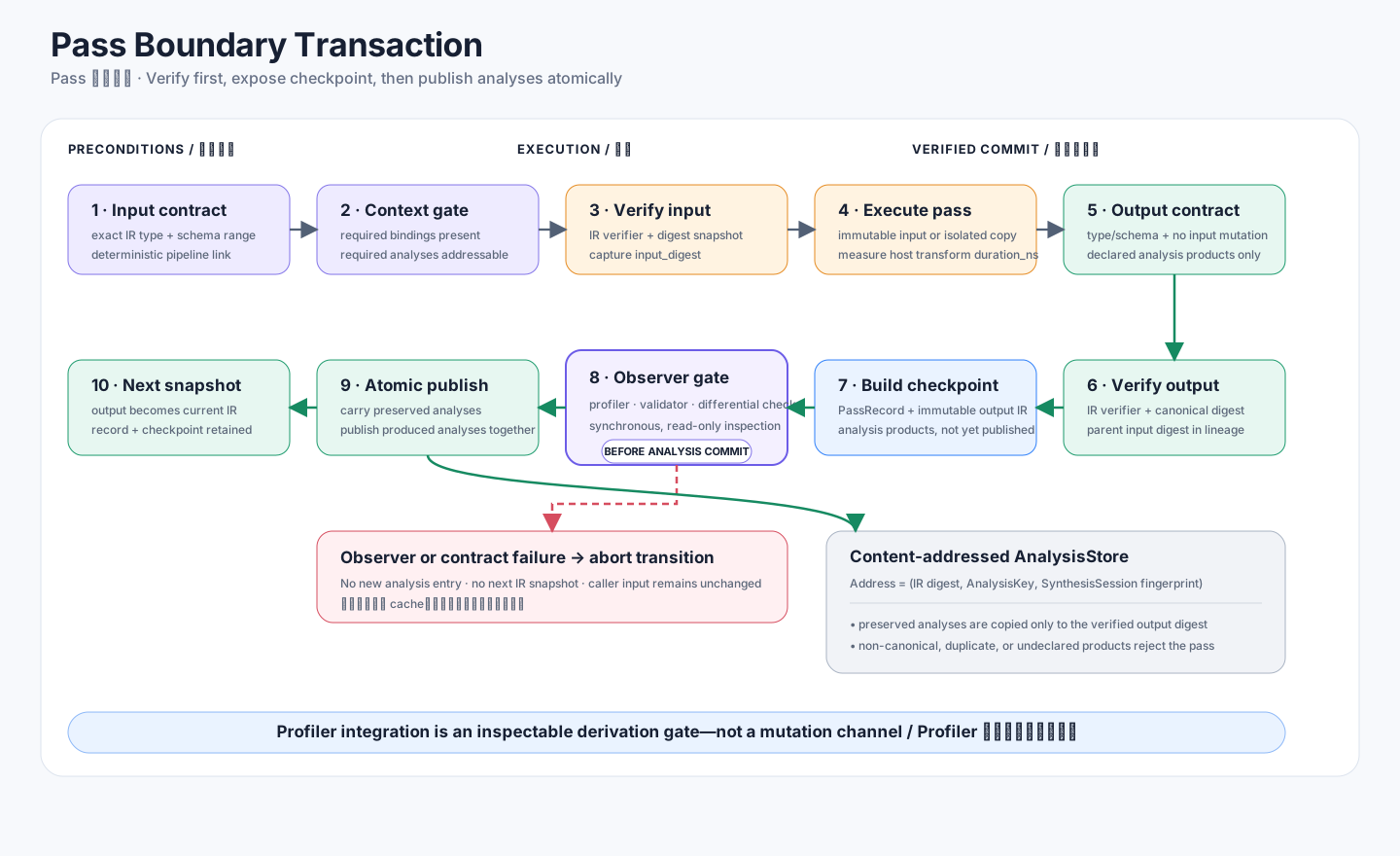
Transformation contract
Every pass declares:
pass identity and contract digest
input IR type and accepted schema range
output IR type and produced schema version
required bindings
required analyses
preserved analyses
produced analyses
mutation model
verification policy
determinism and seed usage
typed lineage relations with independent semantic invariants
an executable canonical normal form
Pipeline composition follows these contracts rather than isinstance checks against concrete pass classes.
Production passes use one low-noise authoring syntax. relation() declares a typed entity mapping, its independent executable semantic invariant, and optional named claims. @derivation derives IR types and exact schemas from DerivationPass[SourceIR, TargetIR] and binds a module-level pure normalizer. The normalizer establishes that the implementation produced the declared canonical construction; relation invariants establish semantic facts such as conservation, legality, and dependency correspondence without treating that implementation as its own proof. Bindings, analysis effects, and relation identities remain explicit. The sole pass decorator constructs metadata only; it neither wraps nor alters run().
Each pass is defined in its output stage:
ModelIR producer            -> stages/model/passes.py
DistributedTaskIR producer  -> stages/distributed/passes.py
PortablePlanIR producer     -> stages/portable_plan/passes.py
ConcretePlanIR producer     -> stages/concrete_plan/passes.py
MachineIR producer          -> stages/machine/passes.py
A dialect module may provide pure derivation functions, but it may not own a second public pass class or hide a contract behind import forwarding.
Transaction sequence
PassManager performs:
check input type/schema
  -> require declared bindings and analyses
  -> verify input snapshot
  -> execute immutable or isolated mutation
  -> check output type/schema and input immutability
  -> verify output and parent lineage
  -> resolve every cross-boundary lineage relation
  -> re-evaluate the canonical normal form and require exact snapshot equality
  -> run every relation's independent semantic invariant
  -> create PassRecord and PassCheckpoint
  -> invoke synchronous observers
  -> atomically preserve/publish analyses
  -> commit the output as the next snapshot
An exception, verifier failure, observer rejection, or undeclared analysis product aborts the transition. The previous snapshot and analysis store remain visible and unchanged.
Analysis store
Analyses are addressed by:
A pass lists every required, preserved, and produced analysis. Preserved products are copied only to the verified output digest. Undeclared products and noncanonical addresses fail the transaction.
Derivation analysis and target evidence are separate stores. The former is keyed to representation snapshots and typed sessions; the latter is keyed to estimate requests and provider revisions.
Checkpoints and observers
PassCheckpoint exposes the immutable output, schema, digest, pass record, session identity, and lineage before analysis publication. Synchronous observers can run stage-specific verification, profiler comparisons, or conservation checks.
Observers are read-only. They cannot rewrite a representation or publish analyses directly. A rejected checkpoint aborts the whole transition, so validation does not leave a partially accepted derivation.
Measurement semantics
PassRecord.duration_ns measures host-side transformation wall time. It is analysis-overhead provenance and never a predicted workload duration. Workload cost lives in evidence-backed views.
Determinism
A pass declares whether it is deterministic and how it uses a seed. CI and opt-in PassManager verification execute deterministic passes twice against isolated analysis-store snapshots, then compare output digests and analysis-product digests. Normal production execution keeps replay disabled. A same-seed replay mismatch aborts before publication.
Search passes may be seeded and budgeted. Candidate order, pruning, and rejection reasons remain provenance so a search result can be replayed.
Analysis and transformation documentation template
Every production analysis or transformation design must include:
- problem and decision authority;
- input assumptions and required analyses;
- transformation algorithm or pseudocode;
- before/after IR example;
- preserved semantics and output invariants;
- complexity and search budget;
- diagnostics and fallback policy;
- checkpoint and profiler integration;
- implementation and test mapping.
Current implementation
The repository implements the transaction runner in src/blueprinting/synthesizer/passes/base.py, keeps the registry implementation in passes/deriving.py, and exposes only @derivation, relation, and claim to extension authors through passes/authoring.py. Public stage passes live in stages/*/passes.py. tests/synthesizer/test_pass_manager.py covers contract inference, failure behavior, and determinism.