Formal Representation Stack
The current five canonical representations are refinement boundaries with explicit ownership, not arbitrary Python models. Their concrete types use the *IR suffix because Blueprinting borrows typed intermediate representations from compiler engineering. Adding or merging a stable boundary requires an ADR and migration evidence; the current layer count is not an immutable law of nature.
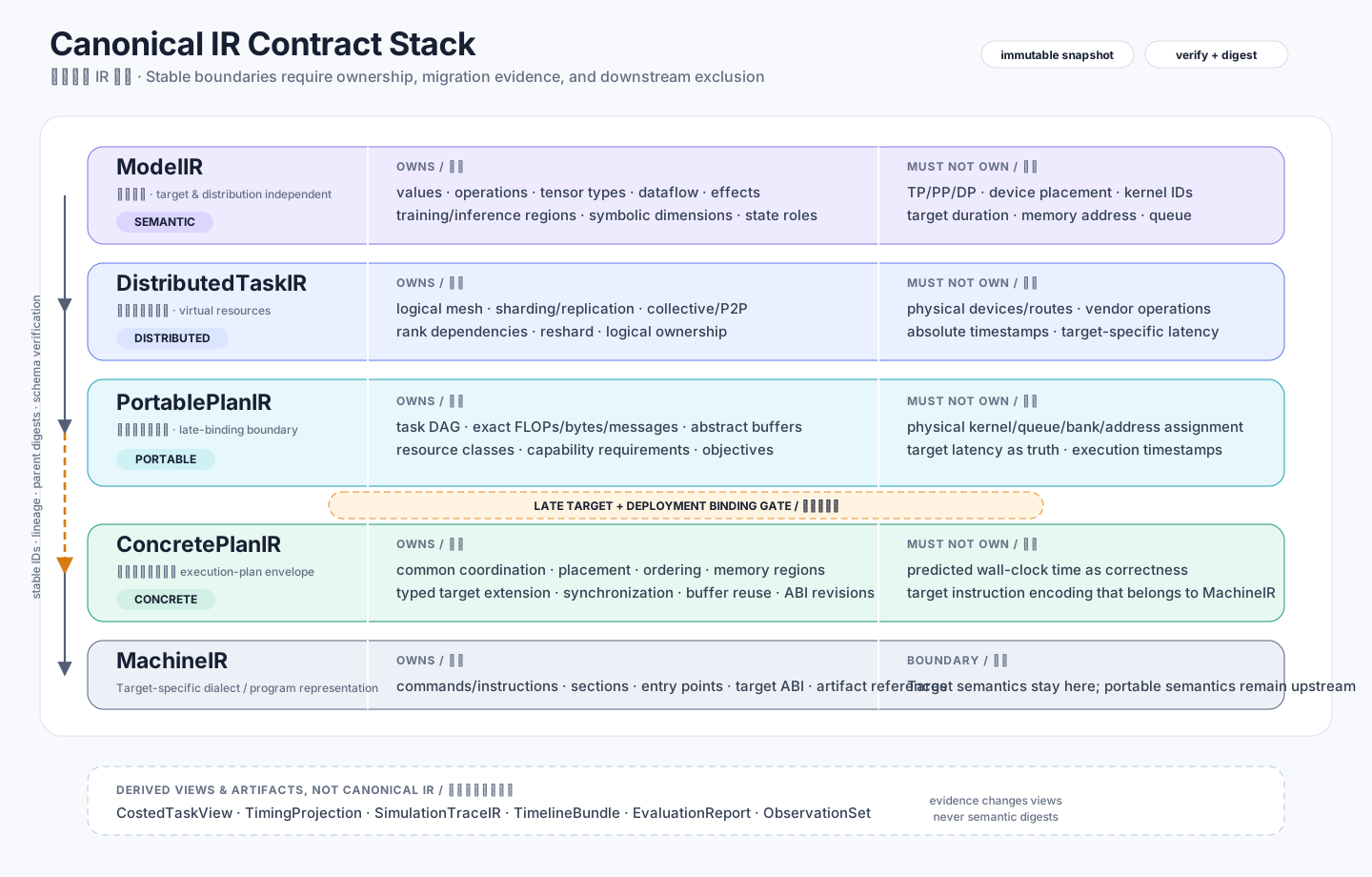
Representation categories
Canonical formal representation
A canonical representation owns authoritative semantics for one derivation stage. It has deterministic serialization, stable identity and lineage, a versioned schema, and a verifier. Current code and tables call these representations IRs.
Derived view
A derived view is reproducibly computed from canonical IR, bindings, evidence, and policy. It may be invalidated and rebuilt and cannot mutate its source. CostedTaskView, TimingProjection, and SimulationTraceIR are derived views.
Artifact
An artifact packages search, reporting, interchange, or execution output. PlanSet, TimelineBundle, EvaluationReport, ObservationSet, and ProgramArtifact are artifacts; being serializable does not make them canonical IR dialects.
Common envelope
Every canonical snapshot contains:
Entities use stable typed IDs. Decomposition records one-to-many lineage; fusion records many-to-one lineage. Snapshots are immutable or transactionally isolated. Types, effects, dependencies, memory semantics, and compatibility-relevant extensions use typed fields rather than free-form dictionaries.
Python definition sites
The five layers are defined in src/blueprinting/synthesizer/stages/<layer>/ir.py; transformations producing each layer are defined directly in the adjacent passes.py. The old synthesizer.ir and synthesizer.lowering compatibility paths are gone, including from internal baseline adapters. See Python Algebraic IR Authoring.
Ownership summary
| Layer | Owns | Must not own |
|---|---|---|
ModelIR |
Values, operations, types, dataflow, effects, model state | Distribution, physical resources, target cost |
DistributedTaskIR |
Logical mesh, shards, collectives, rank dependencies | Physical devices, routes, target implementations |
PortablePlanIR |
Task DAG, exact work, abstract resources/buffers, strategy choices | Kernel IDs, queues, addresses, predicted time |
ConcretePlanIR |
Common coordination core plus typed target-schedule extensions, implementations, placement, ordering, synchronization, buffer plan | Predicted time as correctness, machine encoding |
MachineIR |
Target commands or instructions, sections, entry points, ABI | Reinterpretation of portable semantics |
Information ownership matrix
| Information | First owner | Rule downstream |
|---|---|---|
| Model operation, value, effect | ModelIR |
Referenced through lineage; never reinterpreted |
| Rank, shard, logical collective | DistributedTaskIR |
Target stages only select implementations |
| Exact FLOPs, bytes, messages | PortablePlanIR |
Providers cannot overwrite workload facts |
| Physical device, queue, buffer offset | ConcretePlanIR |
Simulation and MachineIR consume them |
| Target-only dataflow, route, issue/slot constraints | ConcretePlanIR typed extension |
Target verifier, simulation, and MachineIR consume the same version |
| Implementation ID | ConcretePlanIR |
MachineIR encodes it further |
| Target instruction and ABI section | MachineIR |
Artifact refers to the digest |
| Predicted latency and timestamps | Derived views | Never define correctness |
| Actual runtime duration | ObservationSet |
Produces a new calibration revision |
Common verification rules
Every mature canonical contract must verify schema identity, ID uniqueness, reference integrity, lineage validity, deterministic extension encoding, and its layer-specific invariants. A transformation verifies both input and output and records the parent digest. Only the first three layers currently have a production derivation slice; ConcretePlanIR and MachineIR have experimental schemas and structural verifiers, which do not establish complete target legality.
Schema evolution
The codec exposes duplicate-safe raw parsing, and SchemaMigrationRegistry can register deterministic, acyclic, uniquely resolved version steps. Explicit migrated loads verify the source digest, every intermediate snapshot, the final digest, and the ordered migration IDs. A synthetic test schema exercises chaining, ambiguity rejection, no-op loading, and tamper rejection.
All five IR roots are currently at 0.0.0. Canonical record and ADT identities are semantic, versionless names; they do not maintain independent component counters. The production migration registry is empty until a schema is graduated and a real compatibility boundary exists. Snapshots missing required features are still rejected.
Reference pages
- Model and Distributed IR defines target-neutral program and logical-distribution semantics.
- Planning and Execution IR defines portable planning, the target-binding gate, concrete commands, MachineIR, and derived products.
- Python Algebraic IR Authoring defines source layout, record/ADT deriving, and the explicit semantic boundary.