pChronicle architecture
This document explains how pChronicle turns trajectory Sources into durable, queryable history. User workflows belong to Guides, exact commands to Reference, and cross-product ownership to System Design.
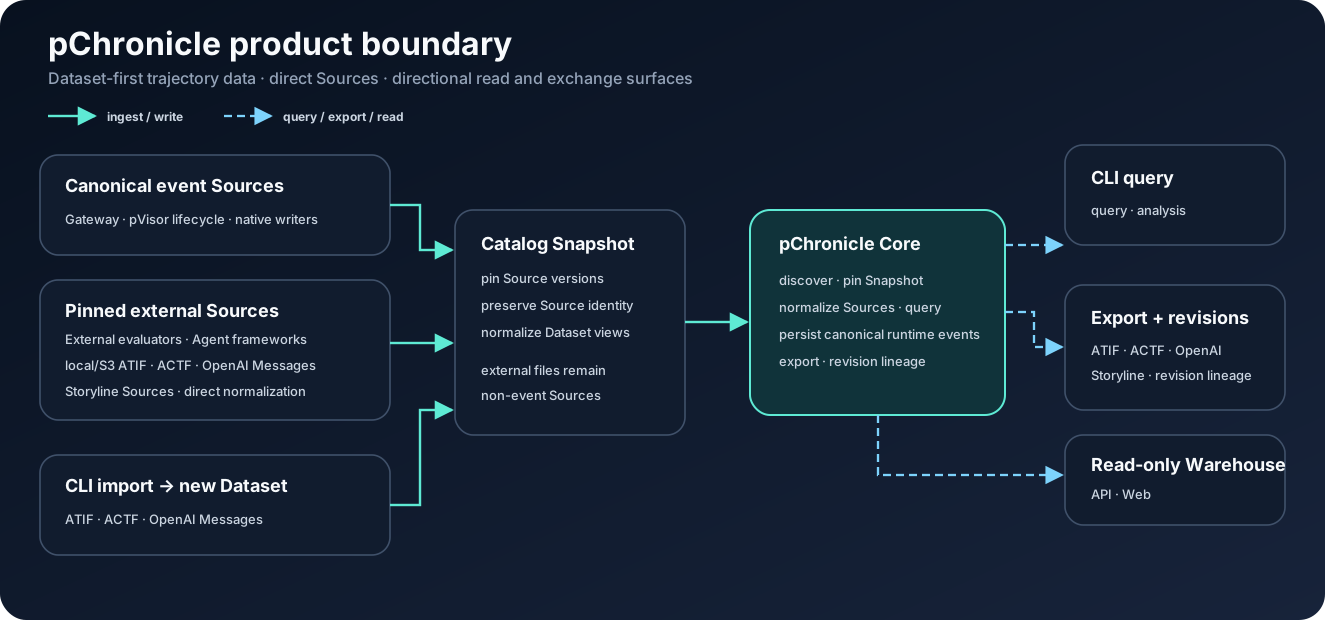
Product boundary
pChronicle is a path-first Agent history layer. It discovers local directories and object-store prefixes, fixes the Source versions used by an operation, normalizes supported representations, and exposes bounded read surfaces.
It has four deployment shapes:
| Shape | Purpose | Persistent state |
|---|---|---|
| direct Dataset | inspect a local path or S3 prefix | none outside the Dataset |
| native Dataset | receive canonical events or create-only import | Dataset manifests and versions |
| default local Warehouse | omit the Dataset argument for one local root | normalized path in user settings |
| read-only Warehouse | mount static Datasets for Web and API review | configuration and rebuildable cache |
pChronicle is not a scheduler, Agent runtime, global Dataset control plane, distributed SQL service, or time-series database. The loopback server has no authentication and is not a production multi-tenant endpoint.
Data layers and ownership
writers and importers
  → canonical events and terminal facts
  → logical Run / Step / ToolCall projections
  → exchange representations
  → lineage-bearing revisions
| Layer | Ownership rule |
|---|---|
| canonical events | write-time facts; append-oriented source of truth |
| logical projection | normalized, rebuildable query view |
| exchange representation | import/export contract; never silently promoted to global truth |
| revision | derived output with parent Snapshot and transform lineage |
Storyline is a session-oriented projection. Its Lance layout is optimized for reconstructing complete documents, so replacement of one session is not the canonical high-rate append path.
Dataset addressing
A normalized Dataset URI is the resource identity. A Source path names one independently discovered and versioned representation inside it. External IDs remain Source-local:
Warehouse mount names are SQL aliases only. Moving data to another URI creates a different Dataset identity. Credentials must not be embedded in Dataset URIs.
Read path
Dataset URI or static mount
  → bounded discovery
  → immutable Catalog Snapshot
  → Source pruning and lazy open
  → normalized DataFusion relations
  → bounded CLI, API, or Web result
One operation fixes each Source's version reference. Local files use identity and fingerprint checks; Lance stores use their published generation or manifest; object stores use a version or conditional ETag where available. The Snapshot does not claim that unrelated Sources share a global transaction time.
Normalized relations include sources, runs, steps, tool_calls, events,
and trajectories when supported by a Source. Every entity relation retains
source_path. SQL is read-only and rejects DDL, DML, network functions, and file
functions.
The detailed discovery and pruning algorithm belongs to Dataset Catalog design.
Write and publication path
Gateway and native writers publish canonical events before derived views. Objects referenced by a Snapshot must be durable before the publication pointer becomes visible. A failed publication leaves the previous Snapshot readable.
validate event
  → persist payload or content-addressed object
  → append canonical fact
  → publish terminal fact or projection generation
  → expose through a later Catalog Snapshot
Writer concurrency is defined by the concrete store contract. Snapshot compare- and-swap alone does not imply merge-and-retry behavior. Unpublished versions and unreachable objects require an explicit maintenance path.
The canonical/projection boundary is detailed in Trajectory storage; the Storyline implementation is documented in Storyline Lance.
Read-only Warehouse
The server mounts a static set of named Datasets. Refresh builds a complete new Catalog Snapshot before switching readers. Dataset tables prune by Source before opening matching fixed versions; caches and routing indexes are tied to that Snapshot generation.
The Web application and API are consumers of the same read model. They do not become another source of truth. Unknown API routes remain errors rather than SPA fallbacks, and only loopback listeners are accepted while authentication is absent.
User setup belongs to the Warehouse guide. Exact routes and
Gateway composition belong to the pchronicle reference.
Guarantees and explicit non-guarantees
| Area | Guarantee | Non-guarantee |
|---|---|---|
| identity | Dataset URI + Source path + original ID remains visible | global uniqueness of external IDs |
| read consistency | fixed Source references within one operation | global transaction across Sources |
| publication | previous Snapshot remains readable until new publication succeeds | automatic merge retry for every writer |
| query | bounded, read-only execution | arbitrary mutation or unbounded service query |
| projection | lineage and rebuildability where declared | projection freshness without a recorded generation |
| service | loopback-only static read surface | authenticated multi-tenant Warehouse |
Related design documents
- Dataset Catalog: discovery, Snapshot construction, lazy Source resolution, and pruning.
- Trajectory storage: canonical facts, physical representations, and write ownership.
- Storyline Lance: three-table projection, content layer, publication, and maintenance.
- Facts, projections, and revisions: the user-facing mental model behind these layers.
- pChronicle Reference: exact CLI and format contracts.