Persisting overview
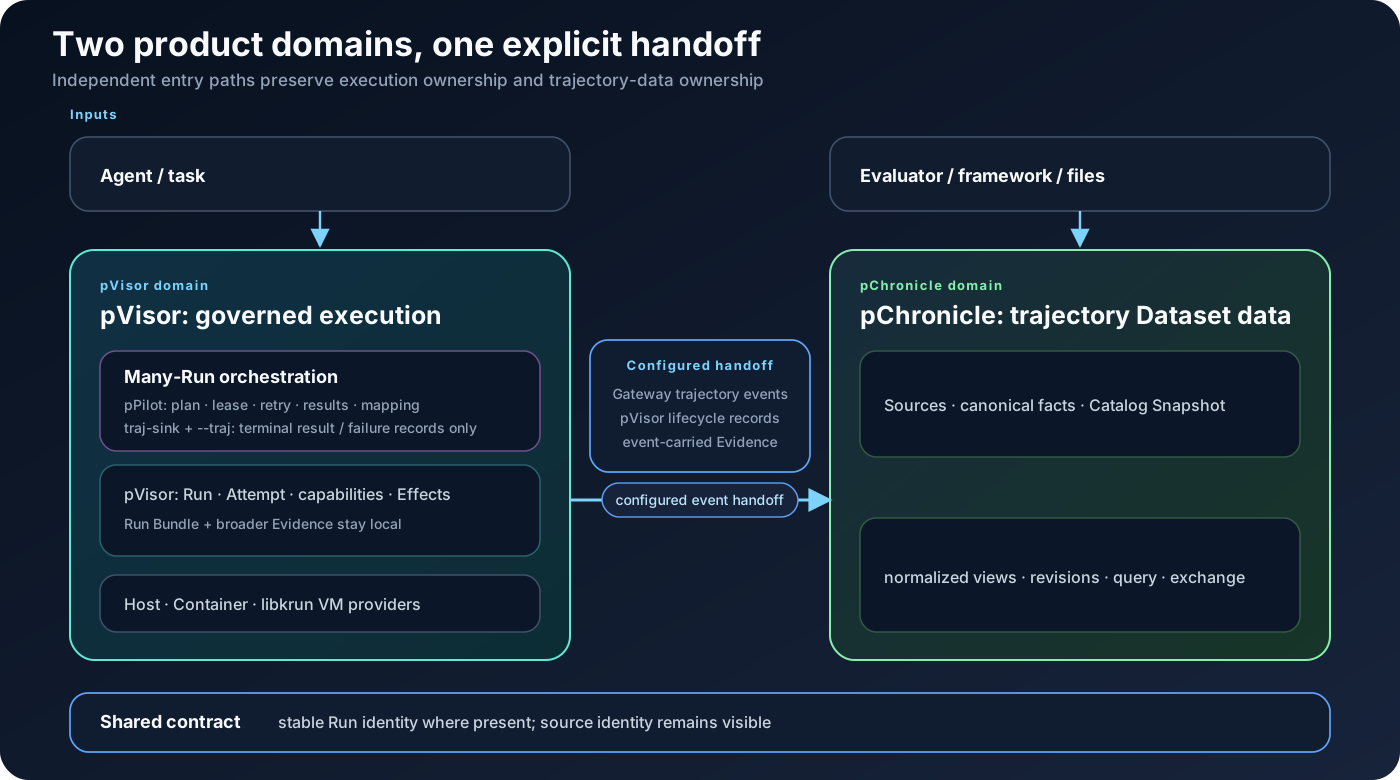
Persisting has two connected entry paths: govern Agent execution with pVisor, or build durable trajectory Datasets with pChronicle. Each path works on its own, and stable contracts connect them when both products are used together.
Two product domains
- pVisor virtualizes and governs Agent execution. pPilot extends the same Run contract to many independent Runs.
- pChronicle turns native and external trajectory Sources into durable, queryable Datasets with preserved origin, normalized views, and lineage.
Where Run identity is present, it remains stable across the product boundary. The implemented configured handoff publishes Gateway trajectory events and pVisor lifecycle records, including Evidence carried by those records. The Run Bundle and its Artifact references, lineage, staged Effects, and broader runtime Evidence remain local unless moved separately. Neither product is only a stage in a mandatory end-to-end lifecycle.
Govern Agent execution
An Agent needs more than a process. It needs a workspace, tools, network
access, credentials, state, and a boundary around the changes it can make.
pvisor creates that boundary for one Run while the underlying host,
container, VM, or fleet resources remain shareable.
The command uses a staged workspace and records the controls actually installed. Run identity does not depend on a process ID or execution provider. After the Run, inspect the result and accept only what should enter the base workspace:
pvisor review last
pvisor apply last --path src
pvisor apply last --include 'tests/**'
pvisor apply last --all
apply is repeatable: each successful call consumes only the selected,
dependency-closed batch, while unselected changes remain staged. Gateway,
OverlayFS, OverlayNet, and Control are pVisor runtime drivers. pVisor produces
a useful Run Bundle without requiring pChronicle at runtime.
Build trajectory Datasets
pChronicle discovers native and external trajectory Sources, preserves their
origin, records Catalog Snapshots, exposes normalized query and exchange views,
and retains revision lineage. External Sources can enter pChronicle without
first passing through pVisor.
The onboarding workflow creates temporary example Datasets without requiring a source checkout. The Dataset is the durable unit for discovery, inspection, exchange, and analysis. pChronicle does not start, schedule, or control Agent Runs.
Use the integrated path
When many governed Runs are needed, pPilot plans tasks, bounds concurrency,
fences leases, records durable results, and reconciles supported crash windows
without changing the Run contract:
The default pPilot path ends with durable results, task-to-Run mapping,
coordination and lease history, and the configured result journal. With the
traj-sink feature and --traj, pPilot additionally emits only terminal
ppilot.result or ppilot.failure records. That option does not capture a
general pVisor trajectory.
pVisor's configured Gateway/lifecycle capture is a separate integration.
Delegated pVisor Runs launched through the current --run-spec path do not
inherit Chronicle capture configuration, and the full Run Bundle remains local.
Guarantees remain source-specific
pVisor records the controls and provider-specific Evidence available for each Run; filesystem confinement does not imply network isolation or control of remote Effects. pChronicle preserves the identity and lineage supplied by each Source, but importing a trajectory cannot retroactively add execution controls or Evidence that the Source did not carry.