Job, Operation, Attempt and Event
A Job is a persistent CLI unit of work. pvisor run creates it; status, kill, inspect, fork, apply and drop operate on it directly. Each current Job has one internal Run record. Disk run-* IDs, run.json and Run Bundle names remain unchanged for compatibility.
The single-node daemon manages OpenSandbox-profile sb-* sandboxes through VM-only NativeRuntime. Private supervisor records bind each generation to native Run/Attempt IDs; sandbox IDs are not public Job IDs. The API does not implement stage/apply, checkpoints or Run Bundle export. Native execution is embedded, but the Job workflow below is not automatically exposed; external orchestration owns cross-host identities.
Operation: the object being processed
Job describes the user's work; Operation describes what pVisor processes. The current production operation is run.execute, containing the program, arguments and working directory along with effective policy decisions and Placement. pvisor owns admission, actual rewrites, scheduling and execution; core defines the records.
Events are externally observable facts; Trace records them. They describe requests, actual rewrites, placement and results. They are not the operation itself and do not guarantee replay of external effects from logs alone. See Operation and Event for fields and causality.
Run: the internal Job record
Run identifies a command, configuration and result independently of the OS PID. After the process exits, local records let status, apply and drop refer to the same work. Use status --review to inspect the Run Bundle and staged changes.
Attempt: one execution
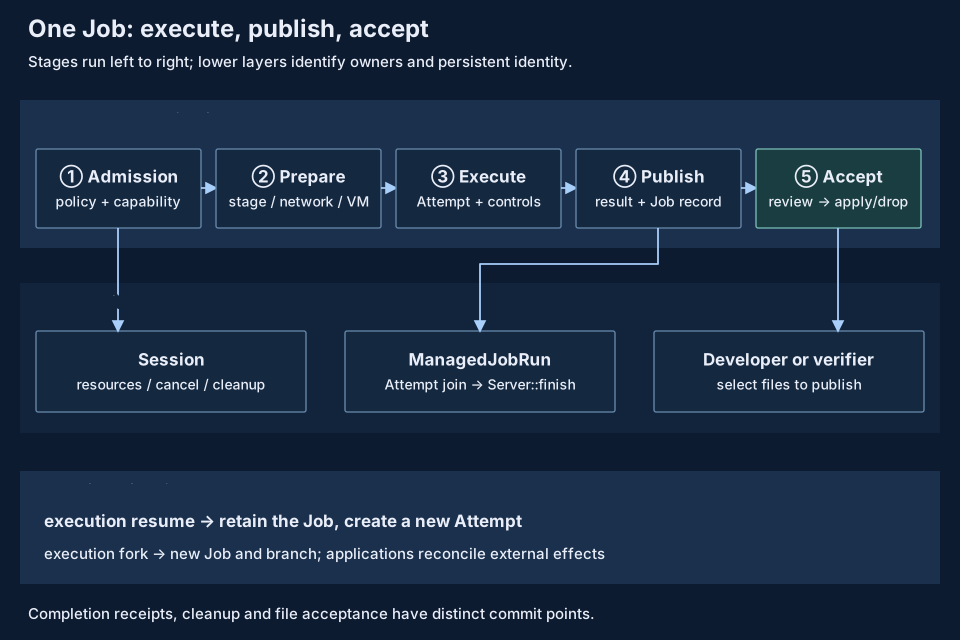
Attempt identifies one execution by an executor. Each current PVisor::run creates one Attempt. Session in pvisor owns preparation, cancellation, cleanup and terminal publication; Session is the lifecycle owner.
Admission resolves the driver network configuration once, applies scoped policies and carries that final configuration into Attempt preparation. Gateway, explicit proxy and VM networking consume it rather than re-reading the original configuration. Guest workspace overlays require an explicit executor opt-in; executor names are descriptive records, not capability checks. The actual VM network attachment path determines non-bypassable network markers; the backend name is not used for this decision.
Workspace fork creates a file branch from a logical checkpoint; execution fork restores a new Job from a supported machine checkpoint. Both retain lineage, with restoration scope determined by checkpoint kind.
The durable Job service also owns completion publication. ManagedJobRun gives the actual Attempt join and Server::finish to a runtime task; frontends hold a wait adapter. A failed or dropped frontend wait requests cancellation, while accepted completion work continues reconciling and publishing as long as the Tokio runtime remains alive. Runtime shutdown and host-process exit retain their own recovery boundaries.
Effect: consequences of execution
For staged files, the current workflow is:
Successful process exit and successful file application are separate results. Files from a failed command remain reviewable; later drop does not undo files already applied.
Network requests and external service changes are effects too. File staging neither delays them until approval nor rolls them back.
Checkpoint: filesystem snapshot
Default fork --state workspace snapshots the upper layer of a stopped staged Run. The embedded API also supports cooperative AgentCtl quiescence. Checkpoints preserve staged files, the conflict baseline captured at first modification and lineage. They do not save process memory or external service state, or freeze all lower layers. The manifest is published only after snapshot contents are synced to disk. Embedded callers use restore_logical_checkpoint(checkpoint, destination_upper, destination_preimages) to restore files and conflict baselines together.
Native VM checkpoint --kind execution seals a consistent CPU, RAM, device and filesystem execution point. Suspend requires the original VM termination receipt; resume retains the Job ID and creates a new Attempt, while execution fork creates a new Job and private writable layers. Apply/drop are unavailable while suspended; kill first withdraws continuation rights. See the CLI reference for profile and compatibility limits.
See Review and apply for steps and Capabilities and evidence for guarantees.