Single-node daemon architecture
Manage local sandboxes through pvisor-daemon: one process accepts resource-bounded creation requests, persists ownership and intentions, controls the native runtime, expires sandboxes and routes access to their prepared services. External orchestration chooses hosts and coordinates business work; it is not a pVisor product control plane.
Responsibilities
| Owner | Responsibility | Outside its scope |
|---|---|---|
| Caller | Workload, prepared image, input versions, retries and business effects | Assuming a timeout proves no execution occurred |
| Daemon | Local admission, ownership, intentions, runtime reconciliation, TTL, authenticated endpoints | Cross-host scheduling or training transactions |
| Native supervisor | Embedded pVisor/VM, RunHandle, acknowledged vCPU controls, cgroup identity, vsock bridges | Stage/apply/checkpoint API or automatic node sharing |
| Prepared image | Supervise argv, initialize and authenticate execd/egress | Replacing lifecycle API authorization |
| Native pVisor | VM execution embedded by supervisors; public Job workflow remains separate | Automatic exposure of stage/checkpoint APIs |
| Native node runtime | Separate immutable backing protocols | Automatic daemon acquisition/sharing |
| Daemon pool component | Optional detached pool enabled by serve --memory-pool |
Pool-process/host-reboot recovery; node acquire/release |
Independent pvisor-cache |
OCI prepare/publish/serve/list/stat/read | Daemon lifecycle ownership |
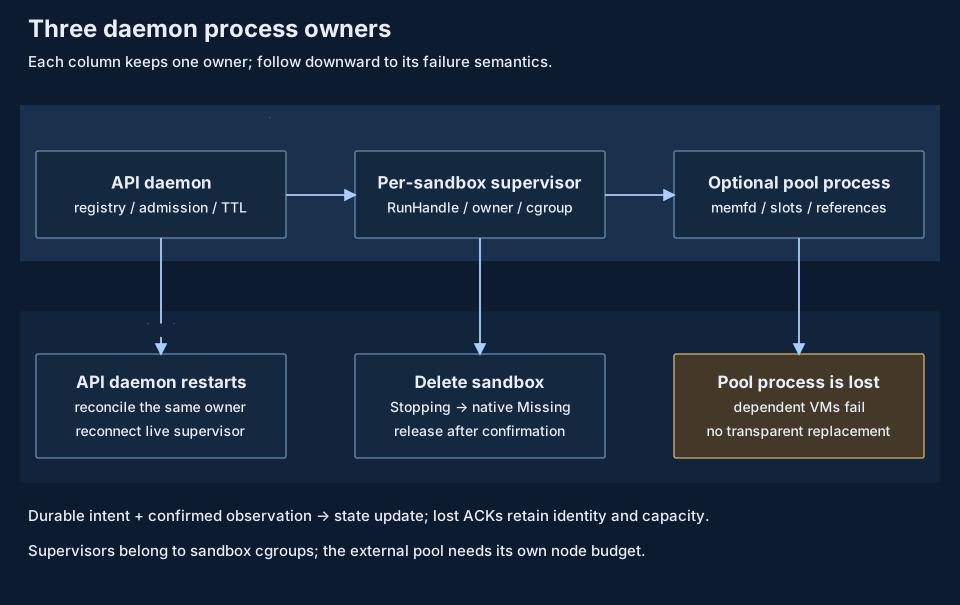
The Runtime trait has one implementation: VM-only NativeRuntime. Detached supervisors embed pvisor::PVisor with only VmExecutor and retain RunHandles across daemon restart. No host/OCI/pull fallback exists. The executable's serve command constructs NativeRuntime using required --images-dir/--cgroup-root; synchronous internal VM dispatch runs before Tokio, and the hidden supervisor command is dispatched. See operations.
Create and access
- Validate the image, argv, environment, metadata, hard CPU/memory limits and optional TTL. Reject unsupported controls before admission.
- Under registry serialization, check local capacity and durably insert a random
sb-*identity, reservation andPendingrecord. - Persist native preparation/identity, install identity-bound cgroup limits, place the child in that cgroup before exec, launch the detached supervisor and verify acknowledged live VM controls plus real service readiness.
- Persist
Runningonly after native creation succeeds. Verified failed-create cleanup releases the record; uncertain cleanup retains its identity and reservation. - Resolve supported service endpoints through the daemon. Inspect reconciles native state; deletion persists intent and confirms native absence before releasing capacity.
This is sandbox management, not a task/result protocol. Private runtime records bind generation to native Run/Attempt IDs, but sb-* is not a public Job ID and the API does not expose Job review, checkpoints or Run Bundle export.
Concurrency and failure boundaries
The registry commit lock serializes capacity checks and durable mutations. A per-sandbox lifecycle lock orders controls and proxy connection establishment; slow VM operations do not hold a global runtime mutex. This keeps unrelated sandboxes moving while preventing two creations from spending the same reservation or a connection from racing daemon-managed deletion.
Durable intentions and live observations have different authority. Persist Stopping before native deletion, and release capacity only after absence is confirmed. Lost IPC or an acknowledgement leaves work to reconcile; it cannot authorize a replacement VM or reusable capacity. A daemon-only restart reconnects surviving supervisors using the same ownership state. Host reboot loses live VMs.
Conservative reservations trade utilization for explicit cleanup accounting: paused, failed and uncertain records remain charged until verified removal. Low RSS and native cache sharing do not reduce those reservations; admission and physical working-set accounting remain separate.
Compatibility and evidence
The partial API profile is pinned to OpenSandbox 1.1.0, release-1.1.0, commit b1a29cf93a823a95913f7943010febb3f29de05c. It is not full API or unmodified SDK end-to-end conformance. The prepared execd/egress image contract has no validated end-to-end recipe yet; see operations.
Native VM execution is wired in the runtime. Stage/apply, checkpoint/fork and offload APIs, Gateway inference-wait coordination and automatic node-resource acquisition are not implemented. Historical Cluster results do not validate daemon SDK conformance, performance or density; no node-wide physical-memory gain is established.
Implementation ownership: crates/pvisor-daemon/src/daemon/{models,store,mod,api}.rs, runtime.rs and main.rs. The retired Cluster implementation is not this architecture.